
How to Avoid Lifting: 5 Common Causes and How to Fix Them
Lifting is one of the most common challenges for nail technicians. It can feel confusing, especially when you are using good products and following your training and can often be the reason you lose confidence in yourself or lose clients. In most cases, lifting is not caused by the brand you are using, but by small technical details in your process. When you understand the reason behind it, the way to fix the issue become far easier to pin down. I recently had this very issue myself, which caused me to step back and re-evaluate my products and processes (find out what caused my issue below!)
Let me go through the 5 most common lifting issues and how we can fix them.
Reason 1: Incomplete Cuticle Removal
Lifting often begins at the cuticle area because non-living tissue has not been fully removed from the nail plate. Pushing the cuticle back is only the first step to proper prep. A thin layer of invisible dead skin can still remain attached to the surface of the nail. If product is applied over this layer, it bonds to tissue that will naturally shed, causing the enhancement to lift. The only way to fix this is to gently and thoroughly remove all non-living tissue from the nail plate before application. Work carefully, use appropriate tools, and check your work under good lighting from multiple angles to ensure the surface is completely clean.
Reason 2: Over-Filing the Natural Nail
It is common to believe that lifting means the nail was not rough enough. In reality, filing too aggressively can weaken the nail plate and reduce adhesion. Deep scratches and excessive thinning create an unstable surface for product to bond to. The fix is to use a suitable grit, usually between 180 and 240 for natural nail preparation, and focus only on removing surface shine only, the aim is never to file the nail plate. A healthy nail plate provides a stronger foundation than an over-filed one. When you overfile the nail plate, you end up removing too many of the tight, compact top layers that product bonds best to. What you are left with is a softer, more porous surface underneath. That surface is weaker and less stable, so the product cannot grip it as securely. As the nail grows and moves, the bond breaks more easily, which shows up as lifting.
Reason 3: Product Touching the Skin (Flooding)
When gel or builder touches the skin, even slightly, it creates a weak point. As the skin moves or sheds naturally, it breaks the seal between the product and the nail. This allows lifting to begin. The fix is to leave a very small gap between the product and the surrounding skin. Apply controlled amounts of product, turn the finger to check the sidewalls, and clean up any contact before curing. Careful application around the cuticle area significantly improves retention. If you need to leave a little gap at the start of your nail journey to avoid flooding, GOOD! That shows you care more for safe application instead of chasing photo perfect application before you have the experience. Closeness comes with practice and knowledge. Don’t rush this.
Reason 4: Poor Structure or No Apex
Lifting is not always a preparation issue. If the nail does not have proper structure, it may bend under normal daily pressure. When the natural nail flexes and the product does not have enough support in the stress area, separation can occur. The fix is to build appropriate thickness where the nail needs strength, particularly in the apex area. Always check the nail from the side to ensure it has balanced structure. Proper shape and support help prevent mechanical lifting.
Reason 5: Contamination After Prep
Even when prep is done correctly, touching the nail afterwards can affect adhesion. Natural oils from the skin, dust, lint, or residue can interfere with bonding. The fix is to keep the nail surface clean after preparation. Use lint-free wipes, cleanse thoroughly, and apply product without unnecessary delay (dehydrators are only effective for about 20-40 minutes after application, so if you apply to both hands and then take longer than this to apply product, the dehydrator is no longer doing it’s job and moisture is beginning to absorb back into the surface layers of the nail. Try applying dehydrator to one hand, applying product, THEN applying dehydrator to the second hand and applying product). Avoid touching the nail or allowing the client to touch their hair or phone before application.
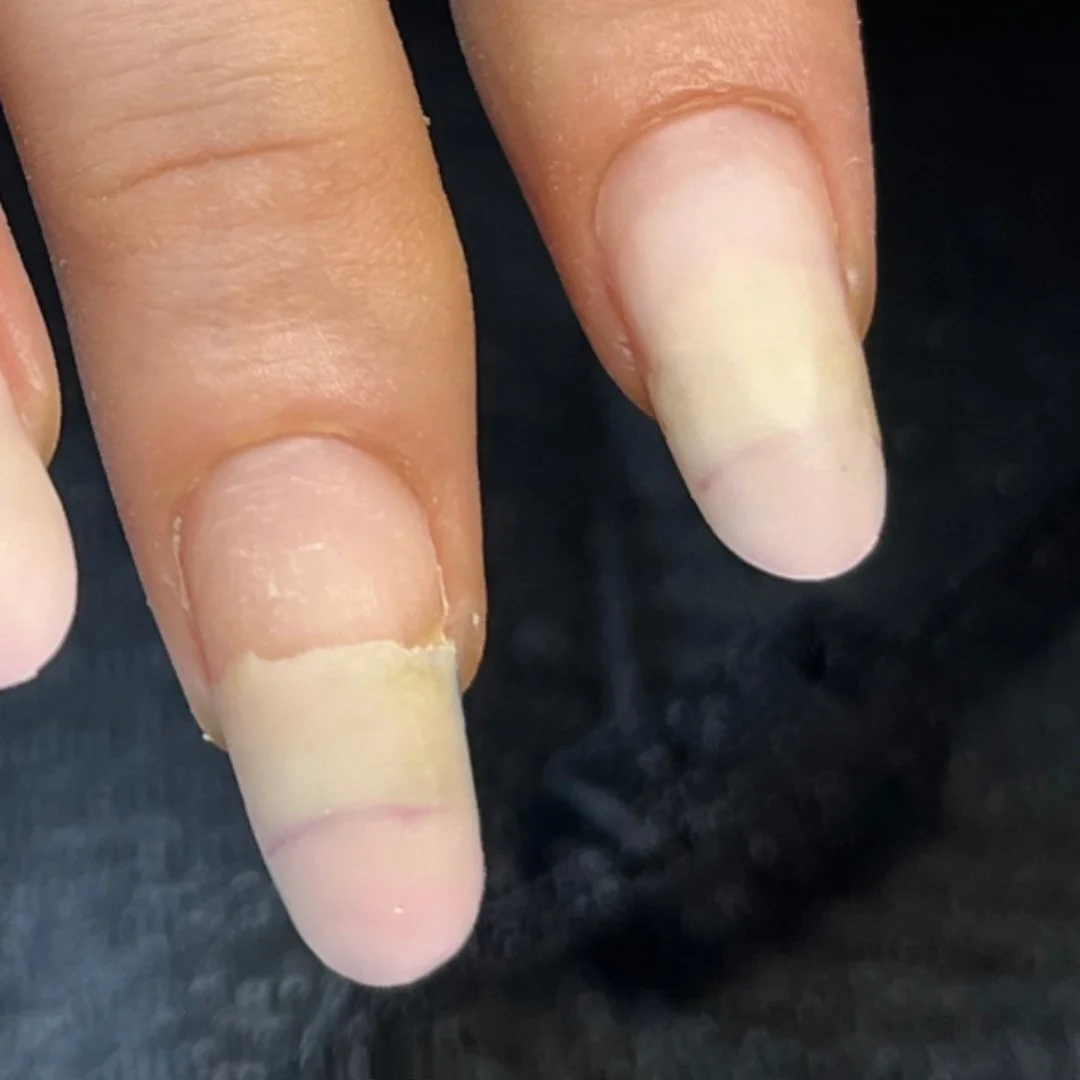
The below photo shows clearly that something went wrong during one particular appointment, as it looks like the entire area that was infilled has lifted, creating a pocket (on the nail on the left this has lifted further and caused some of the enhancement to snap of)
Honourable Mention: Product Performance and Changes
While lifting is most commonly linked to technique, product performance can sometimes play a role. Part of becoming a confident nail technician is learning to understand how your products behave and recognising when something is no longer performing as expected.
For example (and this is the issue I recently faced!), primers rely on solvents to help deliver adhesion ingredients to the nail plate. If a bottle is nearly empty and has been opened frequently, those solvents can slowly evaporate. The small amount left at the bottom may appear normal, but its balance can be altered, making it far less effective. In that situation, lifting may increase even though your preparation has not changed. Replacing products that are old, thickened, or running low is often smarter than trying to stretch them further. Don’t do what I did and try and get every last drop of a product that was clearly finished!
It is also important to stay aware of formula adjustments. When manufacturers update or reformulate products, performance can change, even if the name and packaging remain the same. If you suddenly notice consistent lifting across multiple clients despite no change in your technique, it is reasonable to review whether the product itself may be a contributing factor. Keep a note of the ingredients within your products so you can recognise when something has been changed before issues occur.
Knowing your product means understanding its shelf life, storage requirements, curing needs, and consistency. Strong retention depends on both good technique and reliable materials. When something changes unexpectedly, it is always worth assessing both.
Lifting can feel discouraging in the early stages of your career, but it is usually the result of small, correctable details. By reviewing each step of your process carefully and making thoughtful adjustments, you can significantly improve your retention and build confidence in your technique.
