
After nine years in the nail industry, I've learned that sometimes the smallest changes can make the biggest difference.
I've spent a lot of that time experimenting with different varieties of products, troubleshooting methods and problems, refining my own techniques and trying to understand the science and engineering behind what I do. And the more I’ve learnt, the more I realised how much of a difference it makes when you understand the foundations of the work, rather than simply repeating the techniques you've been taught like a checklist.
That's what inspired my Recalibration Sessions.
I wanted to create something that would let me to share the knowledge I've gained over the years in a way that makes a genuine difference to other nail technicians who may be struggling. They are not another beginner course, not another qualification, and certainly not an opportunity to tell someone everything they've been doing is wrong.
Instead they’re just an opportunity to pause our processes, look at what we're doing, understand why we're doing it and work out where a few adjustments could make all the difference.
And, perhaps most importantly, I wanted to make that opportunity accessible to people who might otherwise struggle to afford it.
What Is a Recalibration Session?
Recalibration isn't about starting again. Instead, it's about taking the skills you already have, breaking them down to help you understand why we do them, and making small, changes that can have a huge impact on your work.
I believe the best way to do that is through in-person education sessions. Having someone personally see your technique, identify areas for improvement and provide guidance tailored specifically to you can be invaluable. Unfortunately, this kind of individual attention is often way out of the price range of a struggling nail tech.
And that just doesn't sit right with me.
For qualified nail technicians who want to revisit their foundations, refine their technique and troubleshoot the things that have been frustrating them, I believe we should be freely sharing information to better the industry as a whole.
That's not to say that educators shouldn't be paid for their time, knowledge and expertise. Our experience has value, and education is a profession in its own right. But I also believe there should be opportunities for technicians to access practical support without having to worry about whether they can afford another expensive course.
When we help individual technicians improve, we raise the standard of our industry collectively.
That's my basis behind Recalibration Sessions.
Coming from an engineering background, the name felt particularly fitting. Recalibration is about assessing how something is performing and making adjustments to bring it back into balance if something isn’t quite right.
It's not about throwing everything away and starting from scratch. It's just about identifying what needs refining and why.
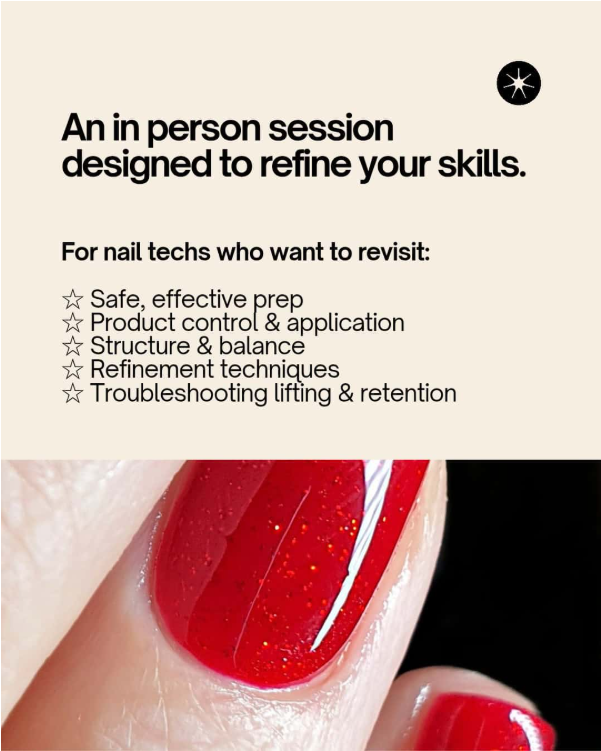
I’m talking about things like:
Safe preparation: Understanding the purpose behind each step, working safely and protecting the natural nail.
Product control and application: Refining placement, staying consistent and precise for cleaner, more controlled results.
Structure and balance: Understanding how to create nails that are aesthetically pleasing, structurally sound and suited to the client.
Refining the finished nail: Working on those little details that can make a significant difference to the overall result.
Troubleshooting: Identifying the causes of recurring problems, such as lifting and breakages, rather than simply treating the symptoms.
Every session is tailored to the individual technician. There's no rigid curriculum that expects everyone to have the same problems or need the same corrections. I start with what you do, identify the areas where improvements can be made, and we work through them together because the aim isn't to make everyone work exactly like me. It's to help you understand your own work well enough to make informed decisions about it.
Three Hours Can Make a Difference
I've already had the opportunity to demonstrate this with my first Recalibration Session, and it's been incredibly rewarding to see what can be achieved through individual guidance!
We spent three hours working through the technician's existing approach, looking at preparation, builder gel application, gel polish application and those finishing touches that can make all the difference.
Rather than immediately jumping in with corrections based off assumptions, I started by watching her work naturally on a single nail. My aim was to see her existing technique and approach to each step and identify where small adjustments could improve the finished result. From there, we worked through those areas together following demonstration where necessary.
We looked at product placement and refining the details of the finished nail. I showed how a liner brush could be used to perfect gel polish application around the sidewalls and cuticle area, as well as how top coat application could be adjusted to improve the line of light.
These aren't necessarily huge changes but they're the kinds of details that can be difficult to identify when you're working alone, particularly when you've repeated the same movements for years.
But the difference was visible.
Within three hours, there was a noticeable improvement in her work.
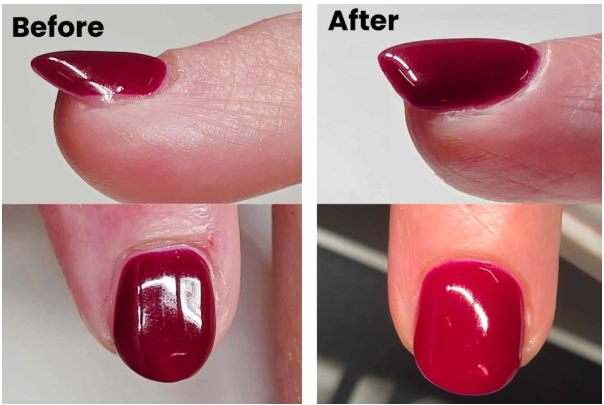
Before and after results from the first Recalibration Session
And that's what I love so much about this approach!
The technician already had the skills. She didn't need to throw everything away, buy a completely new collection of products or be told to start from the beginning. She just needed someone to observe her technique, explain what was happening and help her make the adjustments herself.
Sometimes, that's all it takes to get things moving in the right direction.
It's About Understanding the Why
One of the things I feel strongly about when it comes to nail education is the importance of understanding the reasoning behind our techniques. It's very easy to learn a process by watching someone else do it. We see the steps, replicate them and, hopefully, achieve a similar result, but what happens when something doesn't work?
What happens when a product behaves differently, a particular technique doesn't suit your working style or you encounter a problem you haven't been shown how to solve?
If all we have is a set of basic foundation instructions to follow, we can find ourselves stuck. Understanding why a technique works gives us the ability to think critically, recognise when something isn't working as it should and make adjustments based on knowledge.
This is particularly important when we're talking about safety.
I don't believe there's one universally correct way to approach every aspect of nail services (there is no such thing as right and wrong, only safe and unsafe). Different techniques, products and working methods are all appropriate in different circumstances.
What matters is that we understand what we're doing, why we're doing it and whether our approach is safe and effective or if we’re simply running the motions and falling victim to bad habits. You don't have to be struggling to benefit from that knowledge.
Just because you’re work is already good, it doesn’t mean it can’t be improved.
Your Learning Doesn't End When You Leave
I didn't want Recalibration Sessions to be a case of spending a few hours together, making corrections and then sending someone home to remember everything we've discussed.
We all know how much information can be covered during an intensive learning session. It's easy to forget a detail or find yourself wondering how to apply something when you're back at your own desk. That's why each session includes a personalised educational handbook based on the areas we've covered together.
Rather than giving everyone the same generic handout, the personal handbook reflects the individual technician's session. It explains the areas we've identified organised into paragraphs, the approaches we've discussed and practical ways to continue improving.
It also includes before-and-after photographs of their own work.
That last part is particularly important to me.
It's one thing to tell someone they've improved. It's another to show them their own work and let them see the difference for themselves. Especially added into the handbook so they can look at it again and again. Sometimes, we can be so focused on what we want to improve next that we forget to recognise how far we've already come. I want these handbooks to be something technicians can return to and use as a reference when they're working independently.
The goal isn't to make you dependent on guidance. It's to give you the knowledge and confidence to work things out for yourself.
I'd love for Recalibration to become an ongoing initiative, too. As technicians continue developing their skills, there may be other areas they'd like to revisit or new challenges they'd like help with.
Learning doesn't have to end after one session, and neither does the opportunity to refine our work.
Why Pay What You Can?
This, to me, is the most important part of the whole initiative.
Further education costs a lot of money. And unfortunately, the technicians who are struggling most with their work may also be struggling to earn enough to invest in additional training.
It's a difficult position to be in, one I remember all too well. You can see for yourself that something needs to change, but accessing the support that could help you make that change feels financially out of reach.
One-to-one education is particularly valuable, but it can also be expensive. I wanted to create an opportunity for technicians to access that individual support without a fixed course price becoming a barrier.
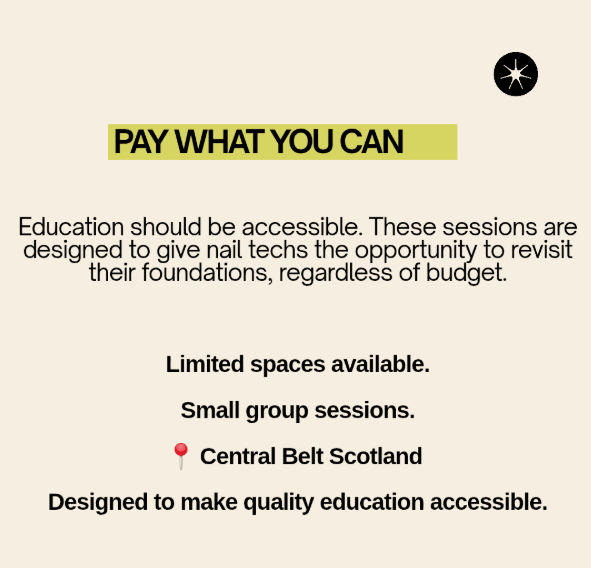
So I made the decision for Recalibration Sessions to operate on a Pay What You Can basis, with no minimum fee.
You contribute whatever amount you can realistically afford. There isn't a minimum payment you have to meet, and you don't need to justify your financial circumstances to me, all I really care about is that you’re commited to learning. The focus will always be on your learning and improvement.
I want to be clear that this isn't about suggesting education has no monetary value. Quite the opposite in fact. I know how much time, work and experience goes into developing the knowledge that allows us to teach others effectively, but I do also believe there should be space within our industry for us to share that knowledge in ways that aren't entirely dictated by someone's disposable income.
Making practical education more accessible gives technicians the opportunity to improve their services, work more confidently and make informed decisions that support both their clients and their businesses. That benefits all of us.
I have nine years of experience behind me, and I'm fortunate to have opportunities to share what I've learned through my work, my content and my education.
Recalibration is another way for me to do that.
It's an opportunity to take the knowledge I've accumulated and use it to support other technicians, particularly those who might otherwise struggle to access this kind of guidance, support and personal feedback.
If I can help someone overcome a frustrating problem, improve their technique and feel more confident in their work, then I've achieved what I set out to do.
Building a Better Industry Together
I think we sometimes put too much pressure on ourselves as nail technicians to have everything figured out. We compare our work to other people's. We assume everyone else knows something we don't. We worry that asking for help will make us look inexperienced. But the fact is, there's no point where we suddenly know everything there is to know about nails. Products evolve. Techniques develop. Our understanding of safety and chemistry improves. And as we gain experience, we find new ways to approach familiar problems. There will always be something else to learn.
I want Recalibration Sessions to be a space where technicians can acknowledge that without feeling embarrassed about it. A space where asking questions is encouraged, where existing skills are recognised and where improvement is something we work towards together.
I'm based in Dunfermline in Fife, and I'm currently offering limited sessions to qualified nail technicians in Fife and the surrounding Central Scotland area.
Keeping the number of spaces limited allows me to give each technician the individual attention they deserve while balancing my client work and other educational commitments.
I'm genuinely excited to see where this initiative goes, but I'd love for it to become something much bigger than just my own sessions. I want to help technicians feel more confident, understand their work more deeply and develop the skills to troubleshoot problems independently. But imagine the difference we could make if more experienced technicians and educators across the industry started offering something similar!
We all have different experiences and areas of expertise. No single educator can teach everything, and I don't think we should be trying to. There's an enormous amount of collective knowledge within our industry, and I believe we could be doing so much more to share it.
I'm not suggesting everyone should start working for free or that educators should feel obligated to give away their time. But if more of us were able to offer even a small amount of accessible, practical support, think about how many technicians could benefit from it and what it would do for our industry as a whole.
A technician who understands their products and techniques more thoroughly is better equipped to work safely, recognise problems before they develop and make informed decisions for their clients. That knowledge doesn't just benefit the individual. It benefits their clients, their businesses and ultimately the reputation of our industry.
And the impact doesn't necessarily stop with that one technician. Knowledge gets shared, conversations happen, questions are asked and better practices begin to spread.
I'd love to see Recalibration inspire other educators and experienced technicians to create their own opportunities for accessible learning, whether that's through one-to-one sessions, small workshops, mentoring or simply being more open to sharing the knowledge they've gained without focusing on the financial return. It doesn't have to look exactly like what I'm doing. In fact, I'd rather it didn't. The more varied the opportunities, the more people we can reach.
I don't want this to be something that belongs to me. I'd love for it to become an idea that other people take, adapt and build upon because helping someone else improve will never diminish our own achievements or expertise.
Education shouldn't be about protecting what we know, but using what we know to make the industry better.
And if we can create a culture where asking for help is normal, sharing knowledge is encouraged and access to improvement isn't entirely dependent on someone's financial circumstances, imagine the standard we could collectively achieve.
Ready to Recalibrate?
If you're a qualified nail technician who's been feeling stuck, struggling with a particular technique or simply wanting to refine your existing skills, I'd love to hear from you. You don't have to be a beginner to revisit the basics. You don't have to be struggling with everything to benefit from some focused guidance. And you certainly don't have to throw away everything you already know to make progress.
Sometimes, you just need another pair of eyes, a little explanation and the opportunity to approach something differently.
Recalibration Sessions are available in Fife and the surrounding Central Scotland area, with limited spaces and a Pay What You Can approach.
If you'd like to find out more, send me a message on social media with RECALIBRATE.
Let's figure out what we can build on. 🖤
